
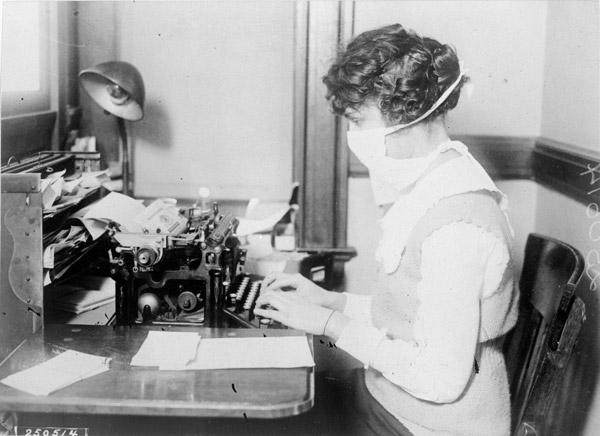
In October 1918, a New York typist worked in a face mask during a deadly influenza pandemic. Public health decisions depend on evidence, but numbers can inform people or frighten them, depending on how they are presented. When a headline says something ‘doubles the risk,’ the first question should be: doubles it from what?
Five traps hidden in impressive numbers
- Relative risk hides the baseline. Going from 1 in 10,000 to 2 in 10,000 is a 100% relative increase but a 0.01 percentage-point absolute increase.
- Average can hide inequality. A rising average wage does not tell you how the lowest-paid workers are doing.
- Correlation is not causation. Two things can rise together because of a third factor, or by coincidence.
- Small samples are volatile. A survey of 40 volunteers rarely tells you what millions think.
- Graphs can exaggerate. Cropped vertical axes, cherry-picked starting dates and missing denominators change the impression.
Whenever you hear ‘most people’ or ‘scientists say,’ ask how the evidence was gathered. Was it a randomized study, an observational dataset, or an online poll? Was the population representative? Were the results replicated? For medical outcomes, what benefits and harms matter to a patient, not merely what reached statistical significance?
A better question than ‘Is the number true?’
Ask: What decision would I make differently because of it? A statistic about risk should ideally show the time period, the comparison group, and an understandable denominator such as ‘out of 1,000 people.’ This does not make every choice easy; it makes uncertainty visible instead of hiding it beneath a percentage.
The habit transfers to election coverage, nutrition studies, financial advertising and viral crime claims. Numbers are not a replacement for judgment. They are a tool for making judgment more accountable.
Sources and further reading
- Cochrane: evidence-based health care
- NHS: clinical trials and evidence
- Example of interpreting a study on sexuality
Historical featured photograph: a real archival image from the year specified in its caption. It illustrates the historical background, not a modern 2026 event.
Discover more from The Confessor
Subscribe to get the latest posts sent to your email.
