
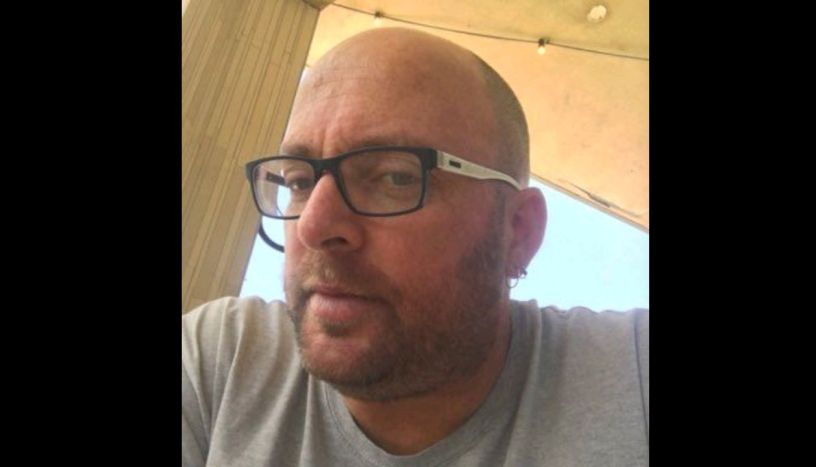
‘I get my heart broken when I talk to people’, Ori Goldberg explaining why he does his shopping in the early morning to avoid overhearing fellow Israeli’s inane conversations. What’s about the maximum level of disarming vulnerability I’ve seen on camera? Ori Goldberg telling young people interviewing not to worry about any sounds of flatulence. ‘It’s me, not you.’ He explains how he has a stoma, because of his colon cancer. Putting people at ease while being forced to knock at whatever afterlife’s door there may be. He wasn’t particularly religious I heard him say in an interview, so I can’t say what Ori thought was awaiting him after his passing at the much too young age of 50, having to leave three children behind.
In every interview he was remarkably welcoming, encouraging interviewers to ask any question burning on their tongues, even very private, uncomfortable ones. He always answered with the same calm tone and serene decorum.
He spoke very openly about his feelings living in a society he labeled as ‘genocidal’, ‘supremacist’ and ‘hollowed out.’
He said: ‘Am crushed’
He spoke of his isolation. How he avoided people, because even friends often spoke with detachment and apathy about the deaths of Palestinians.
‘Am very happy to talk with you’, to a podcaster and you could feel the relief in him.
In at least one interview he is receiving chemo at home and yet there he is. He was generous with his time with podcasters, also small ones, even right after going on Al Jazeera.
He didn’t seem to be interested in attention, but only in sharing his empathy, vulnerability, views and to pay off a debt he felt he had.
He said he felt his sins ‘could never be expunged.’
He called a spade a spade and never minimized or sugar coated anything Israel does.
‘Israel is in it to destroy.’
‘Israel now only cares about death.’
He described how sowing death and destruction was Israel’s idea of victory.
He was convinced there was no bigger strategy, that Israelis were simply jumping at opportunities to kill, without any clear plan for the future.
Netanyahu was not the source of the madness, but only its symbol, its most competent galvanizers of the dark forces long smouldering in the Israeli breast. He explained how even many who vote for him can’t stand Bibi, but need his drive for supremacy.
He was humble and merciless in his self-judgement.
When he said ‘If I was attacked on the street for being Israeli I wouldn’t tell them, hey, am one of the good guys’ you wanted to reach out and hug him.
He explained how he felt he had to stay in Israel, because he had played role in building it through his work at university and for the military.
He was convinced Israel had crossed a Rubicon. That a dark, evil spirit had taken hold of the country and that killing Palestinians was just something that Israelis felt was a task that had to be done. After all, the Palestinians had brought everything on themselves. A society with millions of little children.
He wasn’t sure as to solutions. At times he considered a one state solution and at times a two solutions.
The right of return he supported wholeheartedly.
One of the most profound points he kept hammering was this:
‘If we dehumanize others, we dehumanize ourselves.’
It takes a real fully developed Mensch to say that and mean it and understand the full implications of that wisdom.
He was certain that violence is cyclical in nature and that what Israel was doing to people in Palestine, Iran and Lebanon was certain to come and haunt Israelis.
‘We are the ones being drowned. We are our own victims when we are doing what we are doing.’
He emphasized how his fellow Israelis didn’t realize how reviled they really are and blame all that hatred on typical tropes.
His scariest insights were on how exceptional Israelis feel. How their suffering is the greatest ever and how they were consciously or unconsciously riding that supposed credit.
He had little praise of Israeli opposition voices, because in the end they don’t challenge the occupation or the gradual swallowing up of the West Bank.
whatever sins you claimed to have, the people who embraced you continue your work and the ripple effects are vast, whatever sins you had, they have been expunged.
The idea that Israel had been victorious post-October 7th he emphatically denied. There was no strategic victory, only death, massive damage to Israel’s standing in the world and no real defeat of Israel’s enemies.
Hamas? Still there. Hezbollah? Still there. Iran’s governing system? Alive and kicking and impressively flexible, not tolerant and far from perfect, but flexible and completely misunderstood by the US and Israel and just about everyone else.
Israel’s violence to Ori was merely despair.
A Flucht nach vorne as they say in German.
He did not spare the west or western institutions and indicted those of enabling Israel’s blind mad dog course.
It takes courage to live in society that acts like Israeli society and then to critize that society so openly, so relentlessy and at great cost to one’s self. Ori could have chosen to squeeze maximum personal joy, pleasure and fun experiences out of his days, but instead he devoted most of his time to fighting evil.
Given how many people feel the world has lost some of its brightest, most soothing light after his death, it’s fair to say he touched the hearts of many.
Whatever he did before his Saul on the road to Damascus style fall (meaning a complete change of views, sorry, I was kinda thrown into the classic biblical bath as a kid) am no Catholic priest and it’s not really my right, but I will be forgiven for forgiving this beautiful man. Ego te absolvo, Ori. Your sins, whatever they were, are hereby expunged by the sadness your death have caused, proof of how much good and nourishment you brought to souls hungry for redemption, a fair reckoning and a kinder, disarmed world in the way you were kind and disarming.

