
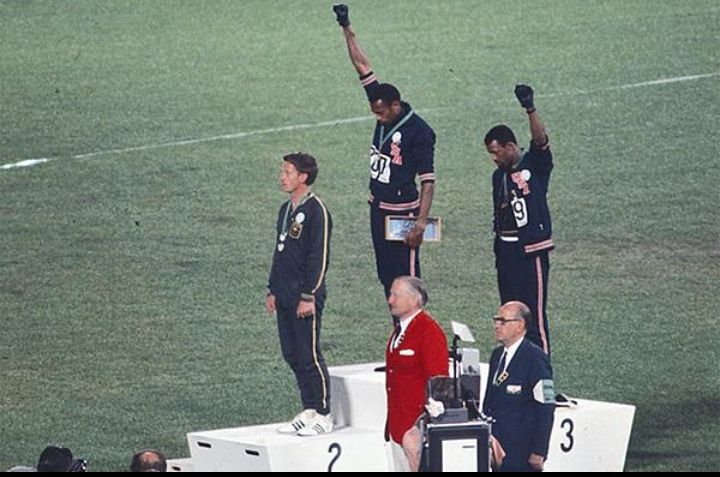
58 years ago this month, three men stood on an Olympic podium in Mexico City.
Two of them, courageous to a level most people will never reach or even aspire to reach, became famous for raising their fists.
The third didn’t raise his fist.
But he knew exactly what was happening.
16 October 1968.
The Olympic Games in Mexico City.
The United States is being torn apart by racial conflict. Martin Luther King has been murdered six months earlier. Black Americans are still fighting for rights that other Americans take for granted.
Two American sprinters, Tommie Smith and John Carlos, have just won gold and bronze in the 200 metres.
Between them stands a 26-year-old white Australian called Peter Norman.
Norman has run the race of his life.
He’s won SILVER, beating Carlos, one of the overwhelming favourites.
His time of 20.06 seconds is so astonishing that it will remain the Australian national record for another 56 years.
He should be thinking about his medal, his future, the applause, the extraordinary doors that might open for him.
But Smith and Carlos have something else on their minds.
They’re planning to protest racial injustice during the medal ceremony.
In front of the entire world.
And they tell Norman what they’re going to do.
Norman is Australian.
The American civil rights movement isn’t his fight.
He could simply stand there, smile politely, collect his silver medal and go home.
Nobody would ever know that he had been given an opportunity to demonstrate moral courage and declined it.
But Norman asks the Americans what he can do to help.
And he tells them:
“I’ll stand with you.”
There’s a practical problem.
Smith and Carlos have planned to wear black gloves, but Carlos has forgotten his pair.
Norman suggests something beautifully simple.
Why don’t they share the remaining pair?
One glove each.
That’s why, in the famous photograph, Smith raises his RIGHT fist and Carlos raises his LEFT.
The Australian also finds himself an Olympic Project for Human Rights badge.
He pins it to his tracksuit.
And the three men step onto the podium.
The American national anthem begins.
Smith and Carlos bow their heads and raise their fists.
Norman stands beside them.
A small white man in an Australian tracksuit, wearing a tiny badge.
It doesn’t look particularly spectacular.
No shouting.
No violence.
No great revolutionary speech.
Just three men saying, in their own ways, that human beings deserve to be treated as human beings.
And the sporting establishment goes NUTS.
Smith and Carlos are expelled from the Games.
They’re denounced, threatened and treated as traitors for daring to make people uncomfortable during a sporting event.
Norman returns to Australia.
His country has its own ugly history of racial exclusion, particularly concerning its Indigenous population.
And there are plenty of Australians who aren’t particularly thrilled that their Olympic silver medallist has associated himself with two Black American protesters.
Norman encounters hostility and ostracism in parts of the sporting world.
Four years later, he isn’t selected for the Munich Olympics.
Norman never repudiates what he did.
Peter Norman dies in 2006, aged 64.
At his funeral in Melbourne, two men have travelled all the way from America.
Tommie Smith.
John Carlos.
The two Black American athletes he had supported 38 years earlier.
And they carry his coffin.
Carlos told the mourners that Norman hadn’t stood in front of them or behind them.
He had stood WITH them.
In 2012, the Australian Parliament finally apologised for Norman’s treatment and its failure to recognise his courage while he was alive.
Forty-four years after the protest.
Six years after the man was dead.
One day governments will offer apologies to journalists sacked for holding Israeli officials’ feet to the fire.
gHopefully before they die.

