On the one side you have a front where units can be shifted easily. On the other side you have a front with pieces that are further apart and not well coordinated. So what would have been a far, far harder blow? Imagine. Hamas crashes through the Apartheid wall (‘security fence’) and overruns bases. Instead of losing time at the festival they push through to the West Bank and link up with militants there.
Crucially Hezbollah immediately launches not a small number of rockets, posing a threat, but nothing Israel cannot easily deal with, no, it launches at least 5,000 missiles. Something it could have done at the time. This capability was later systematically eroded by Israel. Iran then – knowing it will eventually be attacked anyway – launches missiles of its own.
Combined with hostages this becomes an overwhelming shock, especially if because of the all the mayhem happening all at the same time Hamas fighters can likely stay a little longer on Israeli territory. It’s still the Biden administration running the show. They were utterly clueless as to respond, so a bigger shock means even more dilitant and half assing from the Biden administration. This is before Assad is forced to flee Syria, so Israel’s border with Syria, though not critically unsafe, is not entirely without a threat either.
October 7th and the week aftere was the only opportunity for Israel’s enemies to deal some degree of strategic defeat to Israel. October 7th, from a purely military point of view, was now merely an impressive tactical success and because a relatively small number of civilians, even Thai workers who had nothing to do with the whole situation, were killed as well, and Israel still had an uncommon stranglehold over the media narrative, this tactical success evaporated as a military operation and became labeled as a primitive pogrom by the worst kinds of cutthroats.
Israel then made the capital mistake of responding with almost unprecedented barbarity, thereby inflicting a bizarre strategic defeat on itself, but nobody could have foreseen just how willing Israel would be to become the poster boys and girls of savage butchers. The military strategic opportunity was lost. Why is speculation. Are these different actors not real allies? Was Nasrallah of Hezbollah too scared of an Israeli backlash? Was Iran too surprised by Hamas? Did it buy itself time by not launching missiles immediately? There are some arguments to be made for those decisions, but they likely gave Israel all opportunity to play smash with the people in Gaza and the West Bank and eventually also with the Lebanese in south Lebanon and plenty of Iranian citizens.
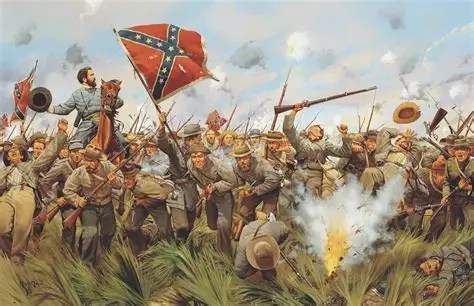
Without boring you with the details: At Gettysburg Lee took the field with about 70,000 soldiers, three large infantry corps, artillery and a cavalry corps. His smaller army was wrapped around a fish hook like position manned by about 90,000 enemy soldiers. He tried his best to get an attack going all along the line, but this failed for many different, rather fascinating reasons, so the enemy’s lines were overrun locally, but never pressure was never sustained enough to prevent the enemy from reinforcing the gaps. To his dying day Lee remained convinced he would have driven the enemy from the field had he been able to move all his attacking pieces simultaneously.
This is broadly similar to what happened to Israel’s position on and right after October 7th. Pressure here, pressure there, but never sustained all over the place. It’s still a remarkable military fiasco for the IDF that they were never able to permanently defeat Hamas in Gaza, but their enemies missed a tiny, still very desperate, window of opportunity to hit Israel in a way that could have sparked a national panic of epic proportions, instead of a painful blow that proved entirely non-vital. So oddly it’s only Israel’s own reaction that turned this Palestinian ‘tet offensive’ into the worst reputation blunder of the century, even worse than the US invasion of Iraq or Afghanistan, apart from being a moral sin of epic proportions.
The opportunity to deal Israel a harder blow in the wake of October 7th is similar to the battle of Gettysburg.