
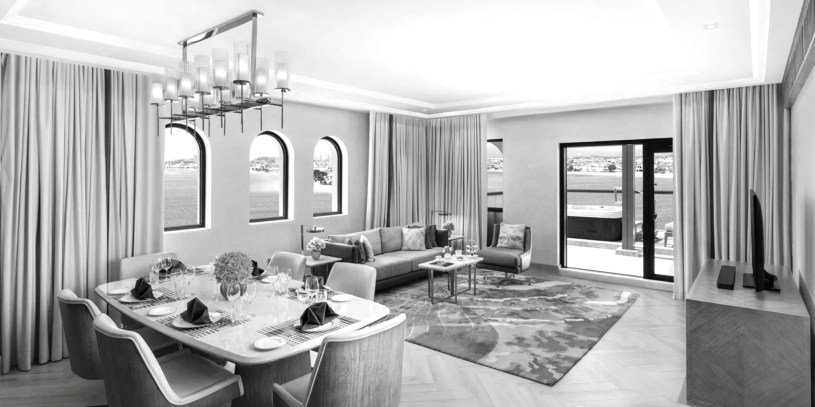
The picture shows a luxury hotel room, because the Predator System is a wolf in sheep’s clothing. It destroys you with sedation, unless you live in its hot zones, zones that haven’t been fully pacified (Gaza, Sudan…) , where you risk being physically erased, but most people’s full range is being castrated by the sedation the predator system peddles relentlessly. One has a better chance of becoming aware of the predator system in a hot zone, where sedation is no longer possible.
No conspiracies, no metaphysical claims — just structural truths most people do not want to see.
1. The predator system rewards sedation, not liberation.
Modern society is optimized for predictability, not aliveness. Anything that makes people more manageable — entertainment loops, endless scrolling, convenience food, hyper-routine jobs, algorithmic dopamine — is supported because it produces stable consumption and minimal disruption. Meanwhile, anything that wakes people up, ignites self-respect, or triggers independent thinking requires effort, emotion, and unpredictability — all of which systems interpret as “cost.” Sedation is rewarded not out of malice, but because numb people slot neatly into economic rhythms. Liberation, by contrast, makes people ask inconvenient questions like: Why am I doing this? Why am I living like this? Who benefits from my exhaustion? And systems rarely enjoy being questioned.
2. The system is not evil — it is indifferent.
Most people imagine human-shaped motives in systems, but systems behave more like weather patterns: they simply follow the path of least resistance that keeps them intact. A system will sacrifice individual wellbeing without hesitation if doing so preserves equilibrium — not because it hates you, but because it doesn’t see you. The suffering of individuals is noise, not signal. This indifference is far more dangerous than intentional evil: evil has a face and can be confronted; indifference has no face and will continue grinding forward until it collapses under its own weight. You are not oppressed by intention — you are steamrolled by momentum.
3. The system thrives on half-lived lives.
A half-alive person consumes more, distracts more, and compensates more. When individuals feel unfulfilled, they become perfect customers for: entertainment, pleasure substitutes, self-help products, processed foods, services that simulate connection, and endless “fixes” for a life that remains structurally unchanged. A fully alive person is dangerous because they require less, they tolerate less bullshit, and they begin to prioritize meaning over consumption. Half-aliveness is not a failure of individuals — it is a predictable result of living in structures that overwork, under-connect, and chronically disorient human beings. A half-lived life is not accidental; it is efficient.
4. Eros is the #1 threat to the system.
Eros — not sex, but erotic aliveness — is the force that makes people reclaim their full agency. A person lit from within becomes less compliant, less fear-driven, and less manipulable. High-erotic individuals take risks, demand truth, step outside prescribed roles, and become emotionally sovereign. This terrifies systems built on monotony and obedience. True eros makes someone say: I want a life worth living, and that single sentence threatens entire economies built on people quietly enduring lives they do not want. Eros is not dangerous because it is wild — it is dangerous because it awakens dignity.
5. Couples are intentionally kept dull and conflict-avoidant.
A passionate couple is a revolutionary unit:
they energize each other, dream bigger, demand more from life, and create meaning outside economic scripts.
A dull couple — exhausted, slightly resentful, and too busy or numb to challenge anything — is stable, predictable, and economically productive.
Systems teach couples to avoid conflict, avoid depth, avoid desire, and avoid truth because real intimacy produces real courage. Two people in survival-mode buy more, work more, and question less. Two people in erotic, emotional, spiritual alliance become a political force — not through protest, but through aliveness.
6. Real adulthood is delayed as long as possible.
A society of adults who know themselves — their values, their limits, their purpose — is extremely hard to control.
So the system pushes prolonged adolescence:
people in their 30s and 40s who still feel like they are “figuring it out,” financially stretched, emotionally unsure, and psychologically unanchored.
This creates a population that behaves like teenagers with bank accounts: high anxiety, high consumption, low sovereignty.
If you want a stable system, delay adulthood.
If you want a stable human being, accelerate it.
Guess which path modern structures choose.
7. The system turns masculine power into pathology.
Not because masculinity is hated, but because unclaimed masculine energy is disruptive: it questions hierarchy, mobilizes communities, creates alternative structures, and refuses to live submissively.
So the system reframes assertiveness as aggression, leadership as toxicity, ambition as selfishness, and boundaries as “problematic.”
This disarms men internally, making them confused about their own instinctive capacities.
A man ashamed of his strength is easier to manage.
A man grounded in his strength is impossible to domesticate.
8. The system feminizes men and masculinizes women.
This is not a moral complaint — it is a structural observation.
Men are encouraged to be emotionally diffused, low–drive, low–agency, conflict-avoidant, and disconnected from embodied power.
Women are encouraged to be hyper-responsible, over-performing, financially driven, and emotionally armored.
This creates two things the system loves:
(a) men too soft to lead themselves, and
(b) women too exhausted to rebel.
And because polarity collapses, eros collapses — which stabilizes consumption and destabilizes family units, creating lifelong dependency on external structures rather than internal bonds.
9. People are taught to distrust their own perceptions.
The most powerful human is the one who trusts their instincts, their senses, their internal “yes” and “no.”
So systems (school, media cultures, corporate structures) subtly train people to doubt their intuition and rely on external authority.
Not by force — by confusion.
By bombarding them with contradictory information, hyper-complex rules, and moral ambiguity until the average person’s inner compass breaks.
A person who does not trust themselves becomes dependent on the system to tell them what is real.
And dependent people do not rebel.
10. “Freedom” in the predator system means choosing your prison cell.
Modern freedom is architectural, not existential.
You can choose your job, your neighborhood, your hobbies, your entertainment — but you cannot choose the deeper structure:
your life must revolve around work, debt, consumption, digital engagement, and the illusion of limitless choice.
Systems give you small freedoms so you don’t notice the big constraints.
You are free to pick the color of your walls — not to dismantle the walls.
And the tragedy is that most people never even realize they’re inside a cage, because the bars are padded with comfort.
 The Confessor