
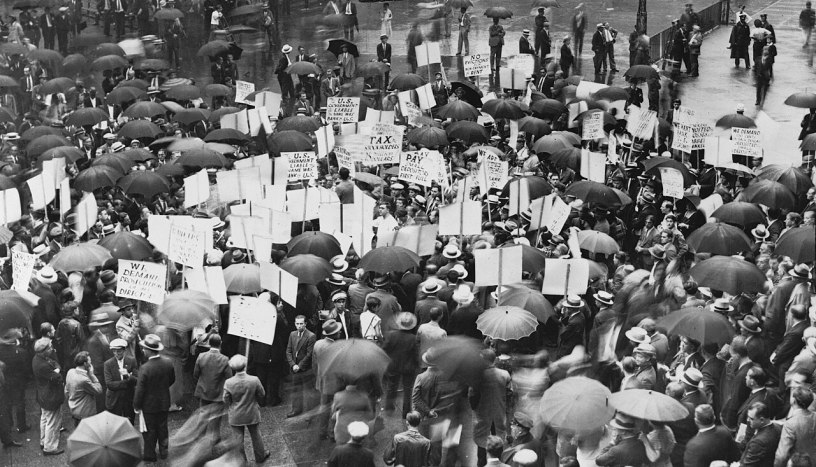
In 1931, people gathered outside a failed New York bank hoping to recover their money. Panic and vanished savings were not abstract economic indicators; they were rent, food and the ability to make it through winter. The photograph on this page belongs to that era. Today’s bank protections and financial products differ by country, but one principle survives: not understanding the terms of money is expensive.
You do not need to become a trader or economist. You do need to understand what inflation does to purchasing power, what interest does to debt, and how a few protections make you less vulnerable to a bad month.
Nine money rules with consequences
- 1. Inflation is a rise in the general price level. If prices rise by 5%, a fixed €100 buys less than before. Individual bills can rise faster or slower than the average; always compare your own main expenses, not just a headline rate.
- 2. Nominal gains are not necessarily real gains. A salary rise of 3% during a 5% increase in prices means purchasing power has generally fallen, even though the number on the payslip is larger.
- 3. Interest compounds. At a hypothetical annual 20% interest rate, €1,000 left entirely unpaid for a year would be about €1,200 under simple annual interest; actual credit-card balances depend on daily calculations, fees and payments. Carrying expensive debt makes time work against you.
- 4. The minimum payment is a floor, not a plan. Paying only the minimum can prolong debt for years. When feasible, paying more reduces interest costs.
- 5. Compare the total cost, not just a monthly instalment. Look for the annual percentage rate, fees, total repayment, penalties and whether a rate can change. A “cheap” monthly payment may hide a much larger total.
- 6. Build an emergency buffer. Begin with a small, accessible sum, then work toward a reserve appropriate to your expenses and job security. Even a modest cushion can prevent one unexpected bill becoming high-interest debt.
- 7. Separate safety money from long-term investment money. Rent due next month is not money to gamble on a volatile asset. Longer-term investments also carry losses, fees and liquidity risks.
- 8. Protect against one-point failures. Keep important documents, account recovery methods and access to essential funds secure. Check the deposit protection rules that actually apply to your country and bank.
- 9. Suspicion is useful when someone promises guaranteed high returns. Ask who regulates the offer, where the money is held, what risks exist and whether you can independently verify the business.
A realistic one-hour money audit
List your monthly income, essential costs, expensive debts, savings and major upcoming payments. Check every recurring subscription and financing agreement. Find the interest rate on each loan or card, not merely the balance. Identify the smallest useful emergency buffer and decide how to automate it. If debt payments are becoming impossible, contact the lender early and seek trustworthy nonprofit or regulated advice rather than hiding from the problem.
What money cannot solve
Money is freedom from some forms of fear, not a complete philosophy of life. It can buy room to refuse exploitation, leave an unsafe situation or spend time with people who matter. But chasing returns is a poor substitute for knowing what the money is for. Financial literacy means being able to make choices rather than having every emergency make them for you.
Sources and further reading
- European Central Bank: What is inflation?
- CFPB: Credit-card interest and minimum payments
- CFPB: Building an emergency fund
Featured historical photograph: Depositors crowd outside a failed New York bank in 1931, photographed for the New York World-Telegram and Sun. Image source and rights are identified in the media caption. The photograph illustrates the historical context, not the events of 2026.
Explore more essential knowledge through Start Here. If this work helps you see the world more clearly, subscribe to DEPTH for free or support independent writing.
Discover more from The Confessor
Subscribe to get the latest posts sent to your email.
