
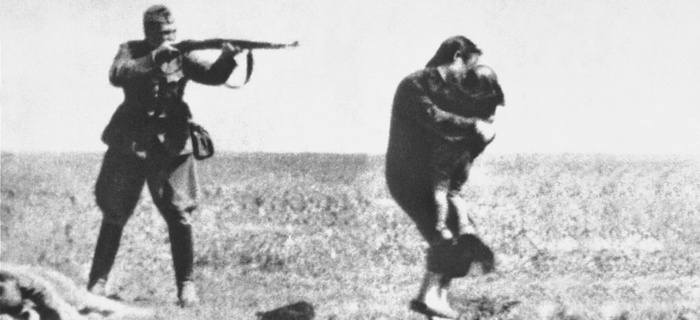
Eighty-five years ago today, Hitler launched Operation Barbarossa, the largest invasion in human history. The war against the Soviet Union was not merely a military campaign. It was conceived as a war of extermination against peoples the Nazi regime considered inferior and expendable. It is worth remembering where that logic leads, how much blood it demands, and how it ultimately ends.
Eventually the Soviets inflicted what they would call a razgrom upon the fascist hordes: a crushing, devastating defeat. At Stalingrad, the Nazi blitzkrieg met its end. The Soviets surrounded more than 300,000 German troops. They surrendered on 2 February 1943.
In a speech on 30 January, Hitler still proclaimed that the German people would fight until final victory was certain. It was his last public speech. From that moment on, Allied victory was only a matter of time—a victory forged in blood, sweat and tears, above all by the Soviet people.
Important: By “turning point” I mean the symbolic turning point—the moment when most people realized that the German army was losing the war. Militarily speaking, Nazi Germany could no longer win after the failure of Operation Typhoon and the Battle of Moscow in December 1941. Historian Sebastian Haffner argued that Hitler understood this perfectly well, making his decision to continue the war all the more cynical.
As early as the mid-1920s, Soviet leaders were already preparing for the possibility of another world war. Fascist regimes were rising across Europe. Mussolini seized power in Italy in October 1922. Hitler came to power in Germany in January 1933. Germany rearmed at full speed. During the First Five-Year Plan (1928–1932), the defense of the young Soviet Union became a top priority.
The Soviet leadership understood the danger. Hitler’s Mein Kampf openly declared Bolshevism to be fascism’s mortal enemy.
Italy proved equally aggressive. In 1935 it invaded Ethiopia. Soviet leaders hoped Europe would finally wake up. They proposed a system of collective European security. Their proposals went nowhere. Soviet intelligence, through agents such as Richard Sorge, repeatedly warned that a German invasion was coming. Until 1941, the Soviet Union launched initiative after initiative in an attempt to build a united front against fascist aggression.
Western Ostriches
The capitalist powers were not interested. Many hoped the Nazis would first destroy the Soviet Union. Britain, France, the United States and Japan had all intervened against the Bolsheviks after the Russian Revolution.
On 24 June 1941, just days after the German invasion, future U.S. President Harry Truman remarked:
“If we see that Germany is winning, we ought to help Russia, and if Russia is winning, we ought to help Germany, and that way let them kill as many as possible.”
Britain and France lost themselves in appeasement. Austria, Czechoslovakia and Slovakia were sacrificed. The Slovak wartime regime even paid Nazi Germany to deport and eliminate its Jewish population—500 Reichsmarks per Jew.
By 1939, the Soviet Union saw little alternative but to sign a non-aggression pact with its mortal enemy.
Resistance to fascism had to come largely from the left. In 1935, Georgi Dimitrov called for a broad Popular Front to unite all anti-fascist forces. Wherever fascists seized power, workers’ rights were dismantled, trade unions crushed, minorities persecuted and democracy hollowed out.
In the fascist worldview of Blut und Boden (“Blood and Soil”), there was no place for those deemed alien, degenerate, inferior or parasitic. Business elites were given free rein, and violence soon followed in the pursuit of markets and empire.
Across Europe, communists often stood at the forefront of resistance. In Slovakia they organized the 1944 National Uprising. In Yugoslavia, communist partisans largely liberated the country themselves.
A War of Extermination
The sense of racial superiority embraced by the Nazi regime led directly to a war of annihilation.
On 3 March 1941, Hitler issued the following directive:
“The war against Russia cannot be conducted in a knightly fashion. It is a struggle of ideologies and races and must be fought with unprecedented, merciless brutality.”
The demand for genocide came not only from Nazi politicians but from leading military figures as well.
On 2 May 1941, General Erich Hoepner wrote:
“The objective of this struggle must be the destruction of present-day Russia.”
The Red Underdog
On 22 June 1941, Nazi Germany invaded the Soviet Union with more than three million soldiers, 3,600 tanks and over 4,000 aircraft, supported by roughly one million allied troops, including Italians, Romanians, Hungarians, Finns and Slovaks.
Operation Barbarossa had begun.
The goals were clear: seize Leningrad, conquer Ukraine, capture the oil fields of the Caucasus, and eventually advance to the so-called A-A Line stretching from Arkhangelsk to Astrakhan.
Expectations were wildly optimistic.
“We have only to kick in the door and the whole rotten structure will come crashing down,” Hitler said of the Soviet Union.
The first weeks seemed to confirm his confidence. Vast Soviet formations were encircled. Yet, contrary to expectations, isolated Soviet units continued fighting stubbornly. German commanders were shocked by the casualty figures.
The diary of German Chief of Staff Franz Halder reveals this surprise. On the first day of the invasion he noted there was no sign of operational collapse. Days later he remarked on the extraordinary stubbornness of Soviet resistance. By August he admitted:
“It is becoming increasingly clear that we underestimated the Russian colossus.”
Factories on Wheels
The invasion created enormous logistical problems for the Germans. Soviet partisans constantly disrupted supply lines.
Meanwhile, the Soviets accomplished something unprecedented. Entire industrial complexes were dismantled west of the Urals and rebuilt further east. By the end of 1941, more than 1,500 major factories had been relocated.
This placed Soviet industry beyond the reach of German bombers.
In 1942, the Soviet Union produced more than three times as many tanks as Germany, including the legendary T-34.
The Soviet system also proved remarkably resilient. Tens of thousands of Communist Party members volunteered for frontline service. Morale held. Production surged.
In December 1941, Soviet forces stopped the Germans outside Moscow. It was the first major German defeat of the Second World War.
Operation Uranus
In the spring of 1942, the Germans attacked again, advancing toward Stalingrad and the Volga.
If the city fell, the Soviets would lose their most important waterway and access to critical oil supplies. Japanese entry into the war against the Soviet Union also remained a possibility.
German bombers reduced Stalingrad to rubble. Ironically, the ruins hindered the attackers more than the defenders. Tanks could barely move through the devastation.
The Soviets clung desperately to a narrow strip along the Volga.
Marshal Georgy Zhukov was tasked with saving the situation. His solution was Operation Uranus: the encirclement of General Friedrich Paulus and the German Sixth Army.
The preparations were conducted in complete secrecy.
The Germans saw nothing coming.
Soviet forces struck the weak Romanian units guarding the German flanks. The two pincers met behind Stalingrad.
Three hundred thousand Axis troops were trapped.
Hitler forbade Paulus from breaking out.
Rattenkrieg
The German press concealed the encirclement for as long as possible.
The airlift intended to sustain the Sixth Army was a disaster. Hermann Göring had promised it could be done. In reality, it was impossible.
The Sixth Army needed roughly 700 tons of supplies per day. Under ideal circumstances, the Luftwaffe could deliver half that amount.
The struggle continued house by house, room by room.
The Soviets developed a culture of elite snipers, producing figures such as Vasily Zaitsev. They blasted holes through walls to move unseen between buildings.
Psychological warfare became relentless. Loudspeakers repeatedly announced:
“Every seven seconds, a German dies in Stalingrad. Stalingrad: Mass Grave.”
The situation became hopeless.
Against Hitler’s orders, Paulus surrendered in February 1943.
The Beginning of the End
The price of fascist arrogance was immense.
Among the 90,000 prisoners were 24 generals. Around 140,000 trapped soldiers had already died. Thousands of tanks, guns, vehicles and aircraft were lost.
In and around Stalingrad, Germany suffered roughly 850,000 casualties.
Faith in final victory evaporated.
A secret German intelligence survey found widespread despair among civilians, who increasingly questioned how the catastrophe had been allowed to happen.
Across occupied Europe, resistance movements intensified.
In May 1945, Nazi Germany was destroyed.
The Soviet Union paid a horrifying price for that victory. Between June 1941 and May 1945, more than 25 million Soviet citizens died. More than 17,000 Soviet soldiers and civilians perished every single day of the war.
Eighty percent of all German military deaths occurred on the Eastern Front.
The lesson is simple.
When a state convinces itself that another people are subhuman, expendable, or obstacles to be removed, it may achieve terrible destruction. It may even appear unstoppable for a time.
But history shows where that road leads.
It leads to mass graves, ruined cities, and ultimately to defeat.

